SIGGRAPH Asia 2026 · Workshop

Beyond Rigid Bodies × Newton for Robotics

Open GPU Physics, Differentiable Simulation, and Multi-Solver Ecosystems for Physical AI and Embodied Robotics

  • Date Thursday, December 3, 2026
  • Time 09:00–17:00 · Kuala Lumpur (UTC+8)
  • Where MR 401/402, Level 4 · Kuala Lumpur, Malaysia
  • Format Full day · Research, demos & discussion
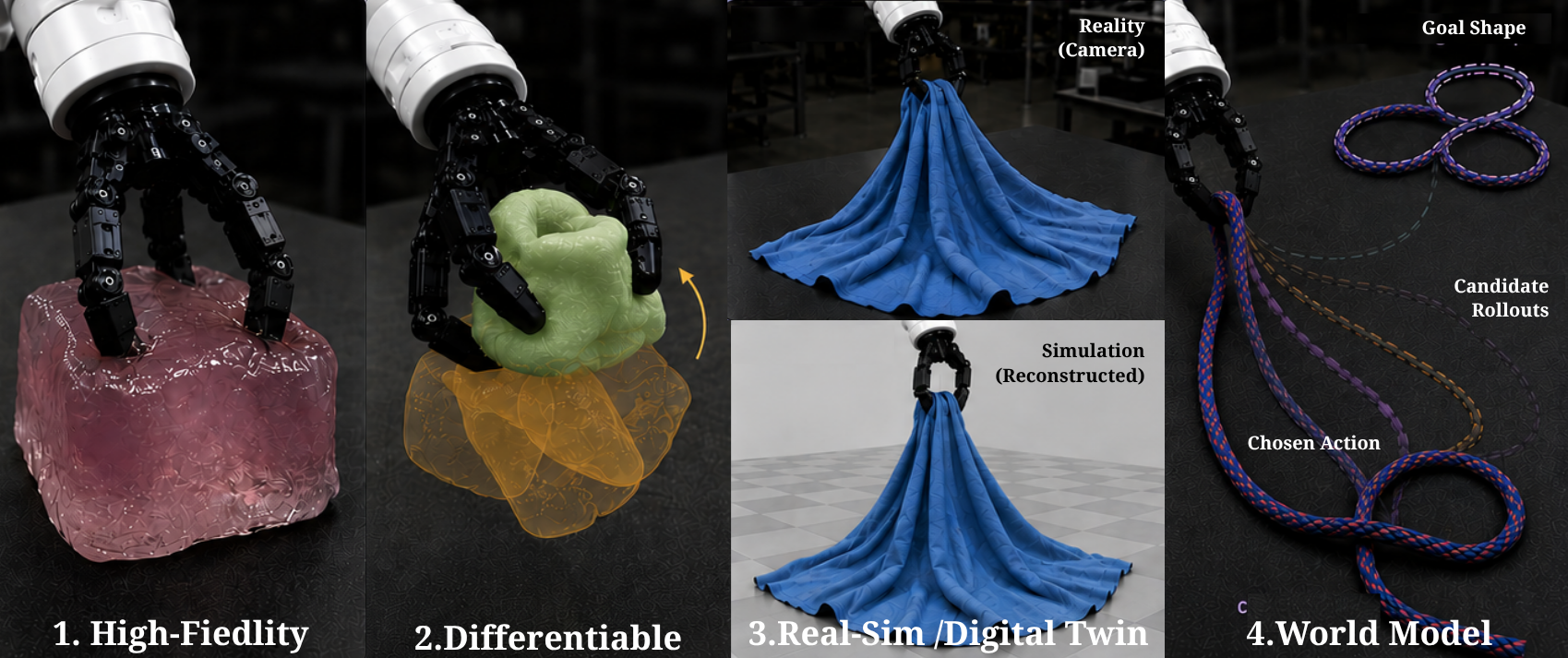
Four robot-manipulation panels: (1) a hand pressing soft tissue, (2) a dexterous hand reorienting a soft object in-hand, (3) cloth reconstructed from a camera into a simulated digital twin, and (4) a deformable cable reshaped toward a goal via predicted rollouts.
The four Beyond Rigid Bodies pillars.

Overview

Simulation, beyond rigid bodies.

One path from programmable physics to research questions, solver choices, and policy evaluation.

An NVIDIA Warp demonstration sets up a shared contact-and-manipulation example. The Taiwan-led Beyond Rigid Bodies team then runs research clinics and group exercises on the four pillars below, turning them into modeling assumptions and validation requirements. Newton and Isaac Lab sessions close the day by testing those requirements against multi-solver interfaces and robot-learning workflows.

Participants jointly produce a task-to-solver decision record, an evaluation checklist, and prioritized open questions. Alternative engines, critical comparisons, and negative results are welcome. No GPU or internet connection is needed for the core activities.

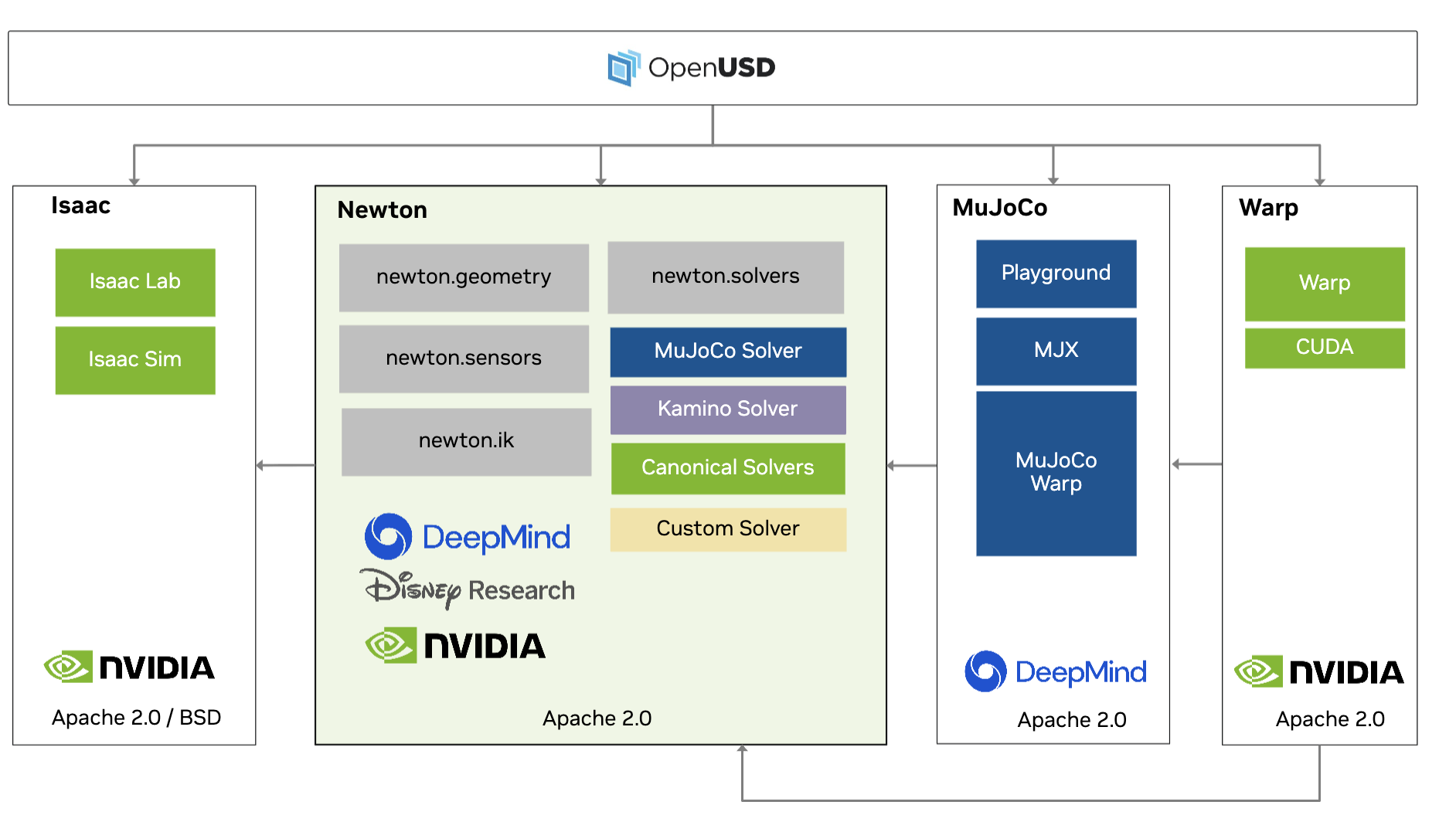
Architecture diagram linking OpenUSD, Isaac, Newton, MuJoCo, and NVIDIA Warp, with shared interfaces and multiple solver paths.
From research requirements to solver decisions.

Four pillars

The technical agenda

i

High-Fidelity Non-Rigid Simulation

FEM, MPM, IPC, frictional contact, compliant materials, cloth, and granular media expose behavior absent from a simple rigid-contact baseline. Participants identify the physical effect that changes task success, the cost of representing it, and a diagnostic scene that tests whether increased fidelity helps.
ii

Differentiable Simulation for Policy Learning

System identification, inverse design, morphology optimization, and policy learning require different derivatives and tolerances for approximation. Participants examine contact discontinuities, stiffness, and long-horizon sensitivity, then choose a gradient check or alternative optimization strategy.

iii

Real2Sim2Real & Digital Twins

Reconstruction, neural scene representations, video-based system identification, and policy evaluation connect observations to a usable physical model. Participants list identifiable parameters, unresolved ambiguities, and held-out observations needed to validate a twin.

iv

Simulation as a World Model

Learned dynamics, neural constitutive models, and structured predictive models can complement physical solvers. Participants ask which predictions a controller needs, how to test consistency over time, and what failures reveal limits to generalization.

Research & industry

Speakers

Schedule · Updated November 5, 2026

Thursday, December 3 · 09:00–17:00

Kuala Lumpur time (UTC+8). Session slots may still change.

  1. 09:00–09:10

    Joint welcome & audience poll

    Organizing teams · Introduce the shared manipulation brief and record questions to revisit at the close.

  2. 09:10–10:00

    NVIDIA Warp introduction & interactive demonstration

    NVIDIA team · Predict a parameter change, inspect the result, and document the baseline’s limits.

  3. 10:00–10:15

    Break

    Informal questions and case collection.

  4. 10:15–10:45

    Reconstruction & digital twins

    Srinath Sridhar · Identify observations, unknown parameters, and a calibration check.

  5. 10:45–11:15

    Structured world models

    Yunzhu Li · Define a useful prediction and a test of generalization.

  6. 11:15–11:30

    Break

    Coffee.

  7. 11:30–11:45

    Case lightning round & group formation

    BRB team · Participants pitch cases and form working groups across the four themes.

  8. 11:45–12:15

    Differentiable simulation & design

    Tao Du · Examine gradient assumptions and specify a check or alternative.

  9. 12:15–13:30

    Lunch

    Informal exchange.

  10. 13:30–14:00

    Contact-rich simulation & control

    Taku Komura · Identify a missing physical effect and a diagnostic scene.

  11. 14:00–14:35

    Newton-based deformable simulation in practice and Newton-conditioned world models

  12. 14:35–15:35

    Newton: solver choices & validation

    NVIDIA team · Map requirements, explore a guided example, and critique solver choices to produce a decision record.

  13. 15:35–15:45

    Break

    Transition between demonstrations.

  14. 15:45–16:45

    Isaac Lab: from simulation to robot learning

    NVIDIA team · Walk through a task, examine a policy rollout and perturbation, and develop an evaluation checklist.

  15. 16:45–17:00

    Joint synthesis & community follow-up

    Organizing teams and participants · Revisit initial questions, finalize checks and open problems, and identify volunteer follow-up owners.

The four 30-minute BRB research clinics (10:15–11:15, 11:45–12:15, and 13:30–14:00) each combine 15 minutes of technical input, 10 minutes of participant work or discussion, and 5 minutes of synthesis.

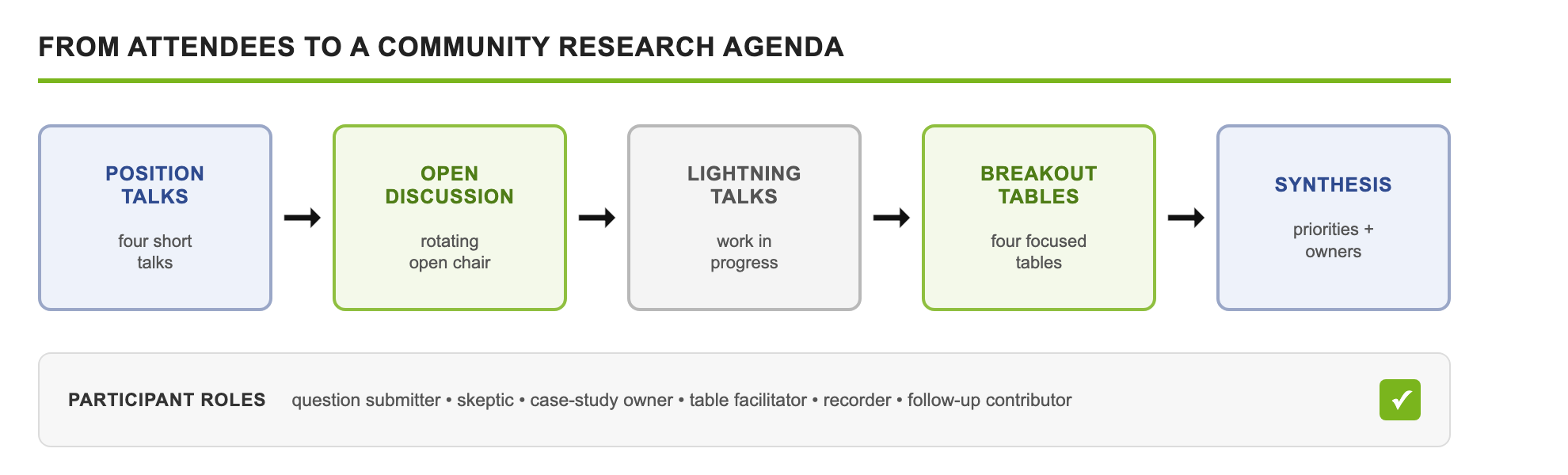
Discussion model connecting short research inputs, open discussion, lightning talks, breakout tables, and synthesis, with participant roles for questions, critique, cases, facilitation, recording, and follow-up.
Discussion activities. Each table has a facilitator, recorder, skeptic, and case owner; attendees may move between themes.

Workshop team

Organizers & contributors

Institutions

National Taiwan University National University of Singapore University of British Columbia National Yang Ming Chiao Tung University The University of Hong Kong Tsinghua University Columbia University Brown University MoonShine Animation Studio Shanda NVIDIA Prana Labs

Bring physics into the loop.

Join us at SIGGRAPH Asia 2026 in Kuala Lumpur.